Home / News and Articles / Getting ready
Getting readyDocuments needed for tax preparation: the complete checklist for 2027.
By Jane Bono · Published · 10 minute read

The single biggest thing that slows a tax return down is a missing document. After more than twenty years of preparing returns in East Dallas, we can tell you that the clients who get their refunds fastest are not the ones with the simplest taxes. They are the ones who walk in with everything in one folder. This guide walks through every document you may need for your 2026 federal return, which you file in early 2027, and explains why each one matters.
Why the right documents matter
Your tax return is a summary of forms that other people have already sent to the IRS. Your employer sends a copy of your W-2. Your bank sends a copy of your 1099-INT. Gig apps and payment platforms send 1099-K and 1099-NEC forms. The IRS matches what is on your return against those copies, usually within months of filing.
When something is left off, the return does not usually get rejected straight away. Instead, a letter arrives later proposing extra tax, interest and sometimes a penalty. The most common one is a CP2000, which we explain in our guide to IRS letters. Bringing every document the first time is the easiest way to avoid that letter.
The second reason is your refund. Credits such as the Earned Income Tax Credit and the Child Tax Credit depend on exact details: who lived with you, for how long, and their Social Security numbers. If we have to wait for one missing card or date of birth, your return waits too.
1. Identity documents for everyone on the return
Start with the people. Every person listed on your return needs to be identified correctly, or the IRS will reject the e-file.
- A valid photo ID for you, and for your spouse if you file jointly. A Texas driver license, state ID or passport all work.
- Social Security cards, or ITIN letters, for you, your spouse and every dependent. The name and number must match Social Security records exactly.
- Dates of birth for everyone on the return.
- Your IRS Identity Protection PIN (IP PIN), if the IRS has issued one to you or a dependent. It changes every year, so bring the newest letter or retrieve it from your IRS online account.
- If someone's name has changed through marriage or divorce, make sure Social Security has been updated. A mismatch is one of the most common reasons an e-file is rejected.
If your ITIN has not been used on a federal return for three years in a row, it may have expired and must be renewed before you file. Read does an ITIN expire? and our ITIN application help.
2. Last year's return and your bank details
- A copy of last year's federal return, if we did not prepare it. It shows carryovers, prior depreciation and estimated payments that affect this year.
- Your bank routing number and account number for direct deposit. A voided check or a screenshot from your banking app is the safest way to get these right.
- If you want your refund split between accounts, bring details for each one.
Direct deposit is the fastest and safest way to receive a refund. The IRS says it issues most refunds within 21 days of accepting an e-filed return, and paper checks take longer. You can track yours at IRS.gov/refunds.
3. Income documents
Bring every form that reports money you received during 2026. Most arrive between mid-January and mid-February. Many are now available online, so check the website or app of each employer, bank and platform you used.
| Form | What it reports | Who sends it |
|---|---|---|
| W-2 | Wages, tips and tax withheld | Every employer you worked for |
| 1099-NEC | Pay for contract or freelance work | Businesses that paid you as a contractor |
| 1099-K | Payments through apps and card processors | Payment platforms and gig apps |
| 1099-MISC | Rents, prizes and other income | Payers of those amounts |
| 1099-G | Unemployment benefits, state refunds | Texas Workforce Commission or other states |
| SSA-1099 | Social Security benefits | Social Security Administration |
| 1099-R | Pensions, annuities, retirement withdrawals | Plan administrators |
| 1099-INT / 1099-DIV | Interest and dividends | Banks and brokers |
| 1099-B | Sales of stock or cryptocurrency | Brokers and exchanges |
| W-2G | Gambling winnings | Casinos and lotteries |
Also bring records of income that did not come with a form: cash jobs, side work, rent from a room, or money paid through Zelle or Cash App below the reporting thresholds. All income is taxable, with or without a form. For the 2026 tax year, businesses only have to send a 1099-NEC once they pay you $2,000 or more, and payment apps only send a 1099-K once you pass $20,000 and 200 payments. That means many people will receive fewer forms but still owe tax on the income. Our article on the new $2,000 threshold explains this in more detail.
4. Documents for the new 2026 deductions
Several deductions created by the 2025 tax law apply to 2026 returns. Each needs its own proof, so set these aside as they arrive.
- Tips: your W-2 or other records showing qualified tip income. A deduction of up to $25,000 is available for qualified tips, subject to income limits.
- Overtime: pay stubs or a W-2 showing the premium part of overtime pay. The deduction is up to $12,500, or $25,000 if married filing jointly, subject to income limits.
- Car loan interest: a statement from your lender showing interest paid on a loan for a qualifying new personal vehicle assembled in the US. The deduction is capped at $10,000 a year.
- Age 65 or older: nothing extra to bring beyond dates of birth, but tell us. An additional deduction of up to $6,000 per qualifying person applies, subject to income limits.
These rules have detailed conditions, and not everyone qualifies. Bring the paperwork and we will check what applies to you.
5. Family, education and health documents
- Childcare costs: the provider's name, address and tax ID number, and the amount you paid. Without the provider's tax ID, the credit can be denied.
- Form 1098-T for college tuition, and receipts for required books and fees.
- Form 1098-E for student loan interest.
- Form 1095-A if you, or anyone on your return, had Marketplace health insurance. This one is essential: a return claiming Marketplace coverage cannot be completed correctly without it.
- Forms 5498-SA and 1099-SA if you have a health savings account.
- Custody or separation papers, if you share children with someone you do not file with. They help decide who claims each child.
- Records showing where each child lived during the year, such as school or medical records, if anyone else could also claim them.
Families with children should also read our family tax credit guide, which explains the Child Tax Credit, the Earned Income Tax Credit and head of household status.

6. Homeowner and itemized deduction records
Most people now take the standard deduction, which for 2026 is $16,100 for single filers, $24,150 for heads of household and $32,200 for married couples filing jointly. Itemizing only helps if your deductible expenses add up to more than that. Bring these records and we will run both ways:
- Form 1098 for mortgage interest, and your property tax statement from Dallas County.
- Receipts for charitable donations. Cash gifts need a bank record or a written receipt; gifts of $250 or more need a written acknowledgement from the charity.
- Large medical and dental bills that you paid yourself.
- Records of state or local taxes paid, such as sales tax on a large purchase.
Our article on standard deduction or itemize explains how the decision is made.
7. Self-employed, gig and business records
If you work for yourself, drive for a delivery or rideshare app, or run a small business, you are taxed on your profit, not on what customers paid you. Every cost you can prove lowers your tax and your self-employment tax.
- A summary of income and expenses for the year, or your business bank and card statements.
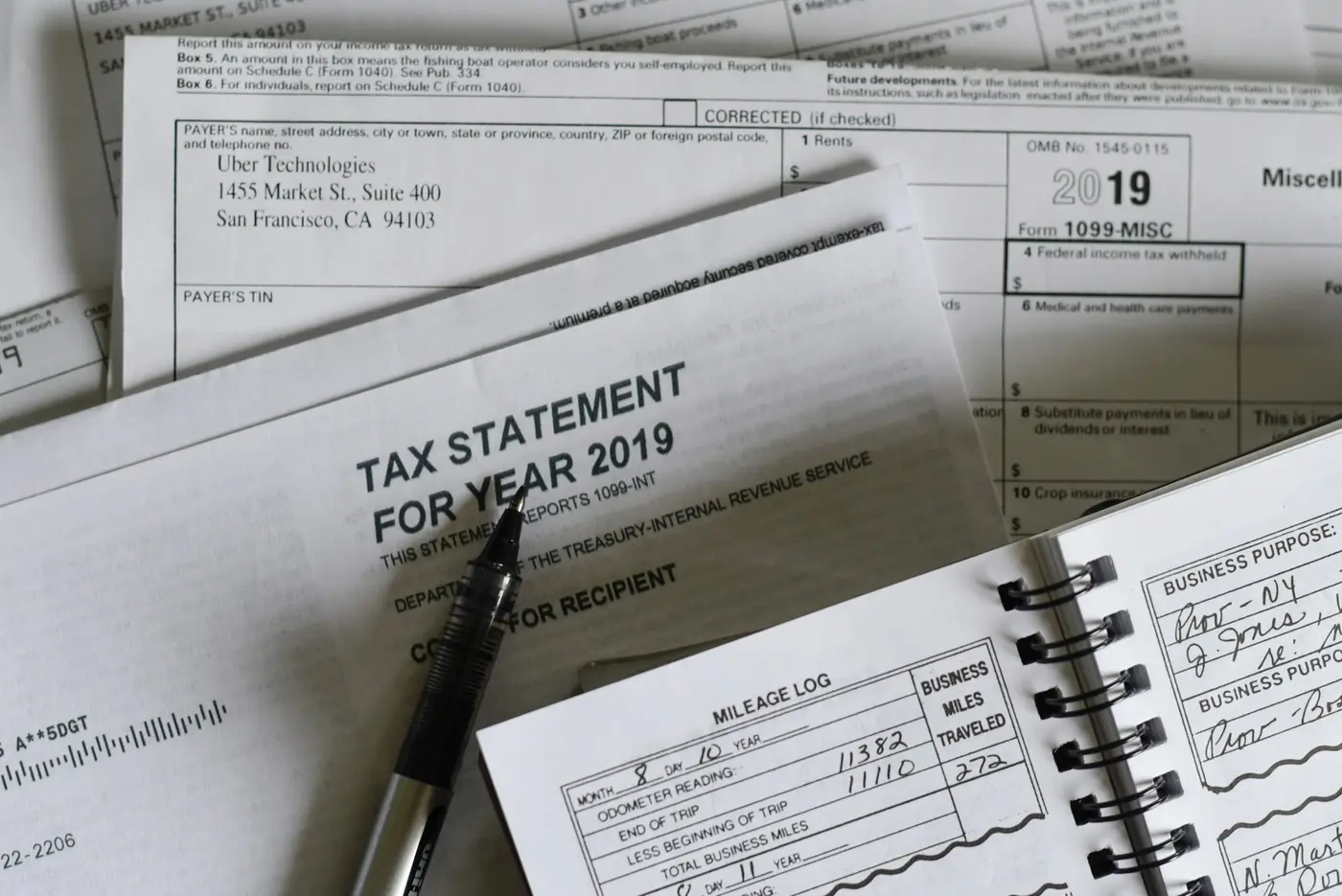
- Every 1099-NEC and 1099-K you received, plus your own record of income paid in cash or by app.
- A mileage log for business driving: dates, destinations, purpose and miles. For 2026 the IRS standard mileage rate is 72.5 cents a mile.
- Receipts for equipment, phones, tools and other large purchases, with the date each was first used.
- Home office details: the square footage of the office and of the whole home, plus rent or mortgage interest, utilities and insurance.
- Records of estimated tax payments you made, with dates and amounts.
- Payroll reports and Forms W-2 and 1099 you issued, if you have workers.
Drivers should read deductions rideshare and delivery drivers miss, and owner-operators our trucker per diem guide. If your records are scattered, our Schedule C tracker sorts income and expenses the way the IRS form asks for them.
8. Rental property records
- Rent received for each property, month by month.
- Mortgage interest, property tax and insurance for each rental.
- Repair, maintenance and management receipts.
- The closing statement from when you bought the property, so depreciation can be set up correctly.
Our rental property deductions guide covers this in depth.
9. Letters from the IRS or the state
If you received any letter from the IRS during the year, bring every page, along with the return it mentions. Notices about a missing form or a math correction can change how this year's return should be prepared. If you owe for earlier years, read owe the IRS? to see your options.
How to share your documents with us
You can bring your documents to our office at 11734 Ferguson Road in East Dallas, Monday to Saturday from 10 am to 7 pm. If you work with us online, call us first and we will tell you the safest way to send them. Please do not email Social Security cards or full account numbers unless we have agreed how they will be sent.
Keep one folder, paper or digital, from January onward. Drop each form in as it arrives. When the folder has a W-2 or 1099 from every place you worked, you are ready to book.
Common questions
Can I file with my last pay stub instead of my W-2?
In some situations a return can be prepared from the final pay stub, but the W-2 is the official record and the numbers must match it. We will tell you what applies to you.
I lost a W-2. What should I do?
Ask the employer for a copy first. Many payroll providers let you download it. If that fails, the IRS can provide a wage and income transcript, which we can help you request.
Do I need receipts for everything?
You need records that prove each deduction or credit you claim. Bank statements help, but receipts or invoices show what was bought. Keep them for at least three years after you file; see how long to keep tax records.
What if I am missing a form when tax season starts?
Book anyway. We can review what you have, tell you exactly what is missing, and finish the return when it arrives.
Is there a printable version of this checklist?
Yes. Use our what-to-bring checklist or the free English and Spanish PDF.
Ready when you are. Book an appointment or call 972-686-1005. This article is general information, not tax advice for your situation; the IRS overview of what to gather is in Publication 17.
This article is general information, not tax advice. What applies to you depends on your situation.
Need help with this?
Your first consultation is free.
 Tax Deadlines and Updates2026 federal tax brackets explained, with examples and charts.
 Self-Employed and 1099Self-employed and 1099 taxes: the complete guide for 2026 returns.
 Tax Deadlines and UpdatesThe new tax law: what changes on your 2026 tax return.